Translate

16 August 2009

Colombo, the Pettah, the Dutch Museum & the von Ranzows

Colombo was called Kalanpu by Ibn Battuta. A mainly Muslim trading port, the Portuguese took it over in 1517 and drove out all the non-Christians. They built a large fort, which encompassed present-day Fort and Pettah.

The Dutch and Sri Lankan armies before Colombo

Allied with the Sinhalese king Rajasinghe II, the Dutch under Gerard Pieterszoon Hulft laid siege to and captured the fort in 1655. The Hollanders were in the employ of the Netherlands East India Company, the Vereenigde Oost-Indische Compagnie or VOC.

The VOC logo

The hitherto feudalistic Lusitanian colony was henceforth to be run with capitalist, Teutonic efficiency. The thrifty Dutch reduced the size of the fort to the area now encompassed within the Colombo city-core known as the 'Fort'. The remainder (outside the new fort) became the outer fort, the 'Pettah'.

Map: Dutch Period Museum marked with orange cross

The Fort is divided from the Pettah by a broad canal, linking the harbour to the Beira lake, which may clearly be seen on the map.

The Dutch Period Museum (larger Photo available here.)

On Prince St in the modern Pettah lies the 'Old Dutch House'. It was built in the late 17th century and was originally the home of the Dutch governor, Thomas van Rhee (1692-1697). In 1796 the British, who displaced the Dutch, took it over and made it into a Military Hospital . Still later it became a post office. The building was restored in 1977-81 and was opened to the public in 1982 as the 'Dutch Period Museum'.

Entrance to the museum

The museum is open daily - except Fridays - from 0900 to 1700 (9 am to 5 pm). Embodying the architectural features of a tropical colonial Dutch town house, it displays old Dutch furniture and artefacts and portrays aspects of contemporary Burgher life and culture.

Old Dutch furniture

Among the items illustrating the Dutch period is a copy of a portrait of Gerard Hulft, the VOC's First Councillor and Director-General of the Indies, Commander-in-Chief of the military forces over the waters of Ceylon and the Coast of India. Hulft was killed during the siege of Colombo.

Gerard Hulft by Flinck (detail)

The original of the portrait by Govert Flinck is at the the Rijksmuseum in Amsterdam.

Among the original occupants of the Old Dutch House was apparently August Carel Fredrik von Ranzow (also known as August Carl Friedrich von Rantzow, 1789-1844), who styled himself Graf (Count). He was a scion of an aristocratic German-Dutch-Danish family with the (rather Ruritanian-sounding) name of von Rantzau , who traced their ancestry back to Charlemagne. A son of Count Ferdinand Anton von Ranzow of Wolffenbuettel, his progeny engendered Brohiers, Sissouws and Greves, among others. He returned to Brunswick and married an equally aristocratic baronness, and three of the ensuing sons returned to serve the VOC in Sri Lanka.

Another relative who served the VOC in Sri Lanka was Daniel Detlef von Rantzow (1741-1822), who is mentioned, in a list of those attending the funeral of a Robertus Cramer, as having married the daughter of OnderKoopman Salomon van Lier: "Anna Sophia Lier married in 1768, being a widow, with count Daniel Ditloff von Ranzow". He appears soon after to have married Johanna Elizabeth Cramer (possibly a relative of the aforementioned Robertus Cramer?).

Altogether, he had 22 children, one of whom, Ludvig Carl (born in Mannar, Sri Lanka) had numerous descendants, including the van Ranzows of California. Ludvig Carl's son Ferdinand appears to have served in Java. The Ranzows certainly went forth and multiplied.

The Slavic-sounding Detlev name seems to have been in the family since the early 1600s. Interestingly, the first von Ranzow immigrant to Australia appears to have been another Daniel Detlev von Ranzow (or Daniel Detloff Von Ranzow - born 1821), who had been transported in 1838 from Prince of Wales Island. The Australian National University's Elena Govor thinks he was Russian, from the Alaskan island of that name.

She says that he had
"non-European looks – yellow skin, dark hair and dark chestnut eyes. It is known that he was a literate man and had served as a captain’s mate on a ship, been arrested for an attempt to murder, sentenced for life in Bombay and deported to Australia. In 1841 he was released on parole."

Penang was named 'Prince of Wales Island' by the British, so he could possibly have been from there, rather than from an island of the same name in Alaska or Canada. It sounds like this Daniel Detlev was a mixed-race Burgher, possibly a descendant of the aforementioned Daniel Detlev. In which case, he was probably the first of many thousands of Sri Lankan Dutch Burgher immigrants to Australia.

11 August 2009

Yudanganawa

Near the town of Buttala in the Moneragala district, is Yudanganawa, an ancient monastery dating back to the 2nd century BC.
Map: Yudanganawa marked in yellow

I went there in early 2005, on the way back from Tsunami relief work in Pottuvil on the East Coast. At the entrance to the complex of Yudanganawa (which means 'woman of battle' or 'beauty of battle') stands the small dagoba of Chulangani or Chulanganawa ('small woman').
Chulangani stupa

Chulanganawa was the site of a battle between King Dutugemunu (Duttha Gamini Abhaya) and his younger brother Tissa (Tisa):

And between those two there came to pass a great battle in Culanganiyapitthi: fell many thousands of the king's men. (Mahawamsa, ch. xxiv)

Tissa not only defeated his older brother, he also captured the king's war-elephant, Kandula. Dutugemunu didn't re-capture his beloved pachyderm until much later. Kandula was the most celebrated elephant in Sri Lanka's history, later being used to batter down the wrought-iron gate of a fortress:

Roaring like thunder he came, daring danger, and with his tusks pierced the panels of the gate and trampled the threshold with his feet; and with uproar the gate crashed to the ground together with the arches of the gate. (Mahawamsa, ch xxv)

As an aside it might be mentioned that, in the 21st century, Kandula's monicker was bestowed on the first male elephant to be born to the Smithsonian zoo by articifial insemination - itself the child of a first-generation Sri Lankan immigrant to the USA.

Amazingly, after his eventual victory, the king commemorated his defeat in this battle by building the Yudanganawa monastery here. It is not often that one hears of a monarch celebrating his setbacks, especially a defeat as humiliating as this one!

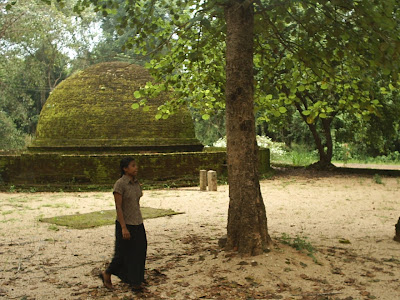
Close by the dagoba is the image house or buduge (literally 'Buddha House'). Only the foundation, the pillars and part of the altar remain.
Image house ('buduge') at Chulanganawa

The approach to the main dagoba at Yudanaganawa reveals its impressive size. It is not as tall as the three large dagobas at Anuradhapura, but it is much broader at the base. Unfortunately the site is heavily forested, so I found it difficult to take a good photograph of the dagoba itself.

Yudanaganawa: main dagoba and image house

I first visited the image house. This is a mediaeval structure, possibly built on foundations similar to those of the Chulangani image house. Inside, it is illustrated in a typical mediaeval manner, with statues of deities and frescos and bas-reliefs on the walls.

The gateway to the inner sanctum is guarded by two painted bas-relief lions rampant. Sri Lanka has not had native lions for many centuries, and the artist was not familiar with what was almost a mythic beast. Hence, the lions looked more like large mastiffs. However they look frightening enough, so their purpose of inspiring awe in the beholder was probably served.

Doorway to inner sanctum of image house

The inner sanctum was very dark and I could just about get photographs of the frescos and statues on my cheapish camera. The art was very mediaeval - a regression from the artistic wonders of the 1st millenium - and, in comparison with the ancient structures visible outside, was not very impressive. That may have been why they installed the two fierce looking guardian lions - to strike terror in the souls of scoffing art critics.

Inner sanctum

The Archaeological Department has been carrying out excavation and conservation work at Yudanganawa for years, and it should continue for at least two decades more. When I went there the scaffolding, which had been erected to help with the archaeological work, was much apparent on the sides of the main dagoba.
Yudanganawa dagoba - note scaffolding for conservation work

The dagoba is quite different in style from conventional stupas - unlike them, it is built in two 'stages', with a smaller dagoba surmounting the massive main structure. It is rather as if the builder had sliced off the middle layer and laid the apex directly onto the base (as is apparent in the photographs below).

Noting that there was nobody around, your doughty correspondent decided to scale the scaffolding and (illicitly and with malice aforethought) climb up on top of the massive dagoba.

The view from the top

The view from the top was quite impressive. It was also good to be able to see, close-up, the consevation work going on right on top of the dagoba. It was quite obvious why this work was necessary - there were trees growing on top of the structure!
Conservation work on top

It was possible to see the hundreds of thousands of bricks of which the dagoba is composed. I wish one could say that the dagoba is made entirely of brick, but I am informed that this is not so: apparently the building contractors of yore were as shifty as their modern counterparts, and many dagobas have cores of clay.
The small stupa on top of the massive base

08 August 2009

More on the Kombuwa

My most illustrious and venerable older sister has given me greater insight into that magical-looking musical instrument, the Kombuwa. The term Kombuwa, originally a Tamil word, also stands for the non-initial letter 'E' in the Sinhala script.
Kombuwa, the Sinhala non-initial 'E'
My copy of Jayalalitha Swami's Tamil-English dictionary advises me that a kombu is the horn of an animal, a wind instrument, a branch of a tree, a shoot of ginger, an elephant's tusk, a pole of a palankeen, a symbol for the vowel 'e', or an opening in the side of a tank through which the water flows in or out.

The pro-Separatist website Tamilnet tells me (in relation to the place name Kompansaintakulam) that Kompu is in Tamil, a branch, a horn of an animal, a musical horn, a tusk; and in Malayalam, a Horn, a tusk, a musical horn, a branch, a pole, a mast, a spear. (P and B are both represented by a single letter in Tamil, hence the two different spellings).

Tamilnet also tells me that the Sinhala kombuwa is a musical instrument shaped like a French horn. However, neither the modern Sinhalese instrument nor the Tamil one look like a French horn. Another website gives more pictures of a Sinhalese kombuwa, for comparison.

The Malayalam (Keralite) one, on the other hand, does look more like a French horn. It also resembles the Sinhala non-initial 'e' letter.

The Tamil letter for the non-initial 'e' looks like this (and the Malayali is similar):
The non-initial 'e' letter in Tamil

Sinhala, Tamil and Malayali are all written in scripts derived from Brahmi. The earliest known examples of the script are on potsherds, dating from the 6th century BC, found at Anuradhapura in Sri Lanka and at Kodumanal in South India.

Hence it is likely that the terms for the letter all originated from a word which meant either 'branch' or 'horn' in a Dravidian or pre-dravidian tongue.

The tusks of an elephant looked like this to a 17th century English illustrator (please try and ignore the man being crushed by the elephant):

Elephant in Knox's Historical Relation

This is a fairly accurate representation, and it bears a strong resemblance to the South-east Indian kompu.

The Sinhalese kombuwa looks more like a French horn which has been untwisted and made straight in a less-than-perfect manner:
Mahanaga school bandleader with a kombuwa

03 August 2009

Oorusitano Tank, Mahagama

Map showing Oorusitano Wewa (cobra location on southern shore)

From the Mahanaga school we continued to the bund of the local tank, which is called the Oorusitano Wewa, built by king Mahanaga (3rd century BC). The tank originally covered an area of over 700 acres (280 hectares) but siltation has led to its shrinking to about 400 acres (160 ha).

Oorusitano Wewa from the south

Mahanaga means 'Great Cobra'. The cobra was a sacred animal - one was said to have given shelter to the Buddha. In Sri Lanka it was a guardian of the waters. Here is the original, carved at the time of Mahanaga, of the seven-headed cobra symbol later used by the Symbionese Liberation Army (of Patty Hearst fame) as its emblem.

Seven-headed cobra (see large image and location here)

There used to be two of these guardstones, but the other was moved to the Lord knows where in the past 4 decades. The cobra was carved in the time of king Mahanaga and was supposed to guard the waters.

Seven-headed cobra (showing relative size)

It lies at a place where a tunnel, part of a watercourse which drew water from the Oorusitano Wewa, discharged itself into the open.

The tunnel

When I looked into the tunnel I found that it was full of bats and smelled of guano. You might just see the bats fluttering in the centre of the photograph, in the light at the end of the tunnel.

Upper surface of the tunnel

A tale surrounds the name of the tank and that of this watercourse. It seems that a child had been found living among wild boar. He was rescued and brought up among humans and given the name of Sookara Sitano or Ooru Sitano, meaning Mr Pig. When Mahanaga built the tank, the entry to the watercourse (the sorrowwa) was hidden. Nobody knew how to control the flow of water out of the tank.

A silt trap in the middle of the tunnel.

Mr Pig had a magic clay pot. He would shake the pot and water would rush through the watercourse. One day somebody made a hole in the pot, so it lost its magic. The water would not flow. Therefore Mr Pig and his wife flung themselves into the water and water began to flow down the watercourse. When Mr Pig fell into the water, he made a 'buck' sound, his wife hit the water with a 'bock'. Hence the watercourse was known as the Buck-bock sorowwa.

Children swimming in the new watercourse

Today a new watercourse has replaced the Buck-bock sorowwa. I went down to its shores and one of the boys bathing in it shouted that there was a diya balla, a 'water dog' behind me. I looked round and spied an Indian Otter (lutra lutra nair) on the far bank. It dived in just before I could take a photograph. Its head is just visible underwater, just below the rocks on the centre-left and just to the right of the clump of grass on the right of the photograph.

New watercourse, looking downstream

On the road to Mahagama

Map of the hinterland of Hambantota, showing Mahagama
On the weekend I went to Mahagama, close to Sevenagala. This Mahagama was one of several ancient towns of that name, which were capitals of the southern Sri Lankan principality of Rohana (modern Ruhuna). This particular village is said to be the capital of Mahanaga, the brother of king Devanampiya Tissa, who fled Anuradhapura and established his own kingdom in the south.

To get to Mahagama we turned left (eastwards) just before Embilipitiya and drove along the dam (the bund) of the Udawalawe tank (reservoir) .

Bund of Udawalawe reservoir
The Udawalawe tank was created by damming the upper reaches of the Walawe river in order to provide water for the farmers of lower Sabaragamuwa and Ruhuna. The main road to the Udawalawe elephant sanctuary and beyond lies on top of the bund.

Approaching the Udawalawe sanctuary, we pass European tourists who have hired Land Rovers and are out for a good day of elephant spotting - Udawalawe is one of the best places for seeing Sri Lankan elephants (elaphas maximus).
European tourists
Udawalawe sanctuary is marked by an electified barbed wire fence. Some elephants gather along the fence to get goodies from visitors, like this one:

Elephant, Udawalawe reserve
Some years ago, one of these elephants had managed to cross the fence and had ravaged the nearby houses. However, the villagers told us that they have not had any problems recently.

The elections to the Uva Provincial Council were due on 8th August, so the campaign was in full swing. Opposite where I took the picture of the elephant was an 'election office' of the ruling United People's Freedom Alliance, festooned with posters of candidates. Moneragala is a classic centre-left district, so UPFA posters were much more in evidence than that of the other parties.

UPFA 'election office'
A TV programme featuring Shasheendra Rajapaksa, one of the prospective UPFA candidates for the Moneragala district of the Uva province (13 is his lucky number!) was due to be videotaped at the Mahanaga school at Mahagama. I found the school band ready to welcome the guests, who were late; the band was restive.

Mahanaga school band
The band, who were dressed in saris, had an interesting mix of western and oriental instruments. The leader, on the right of the photograph, carried a curvy horn known as a kombuwa.