The ancient Sinhalese chronicle, the Culavamasa tells us that the consort of Manabharana, the crown prince of Sri Lanka,
... bore a son at a moment marked by a lucky constellation. Clear at this moment were all the quarters of the heavens and cool, fragrant, gentle breezes blew. With the trumpeting of the elephants and the neighing of the horses the royal courtyard was filled with resounding din.
This heavenly event took place in a city known as Punkhagama, the capital of the principality of Dakkhinadesa, of which Manabharana was the sub-king (yuvaraja).
The child was named Parakramabahu (Parakkamabahu in Pali). Many years later, about 1153 AD he became king of the whole island as Parakramabahu I (the Great). He then constructed a shrine at the place of his birth, the Suthigara Cetiya (the Chaitya of the house of birth).
Interestingly, when Wilhelm Geiger (the father of Hans, the inventor of the Geiger Counter) was translating the Culawamsa, the location of Punkhagama had not yet been discovered. Geiger Snr tells us in a footnote that 'Parakkamabahu 1 erected a tope there 120 cubits high of which there ought still to be traces'.

Archaeological department board at the Kotavehera
This tope was identified later as the Kotavehera, in the modern village of Dedigama (pronounced tha-thee-gah-muh), and excavations were carried out there in the 1960s. So Punkhagama is most likely Dedigama. Apparently the place-name is derived from Jatigama, an alternative ancient name for the place.
The dagoba is the largest in the Wet Zone of Sri Lanka. Parakramabahu I was a great lover of monumental architecture and bigness generally. He made tanks in the Wet Zone (where they were not really necessary) in order to show off his prowess and in order to recreate the 'Milk Ocean' in a large-scale Mandala, a representation of the Indic Cosmos .
Obviously I am not a great fan of Parakramabahu's - his reputation was as much due to his panegyrist in the Culawamsa as anything he did; although it was possibly his unification of the Mahayana and Theravada Buddhist clergy in a single, state-controlled body which ensured for him a sympathetic press.
 Sutighara cetiya from the north-east
Be that as it may, the dagoba is truly impressive. It is 78 metres (256 feet) in diameter and 14.3 metres (47 feet) high. I couldn't get the whole thing onto a single frame, so I had to do a stitch-up of two photos - a bit of a botch-up actually.
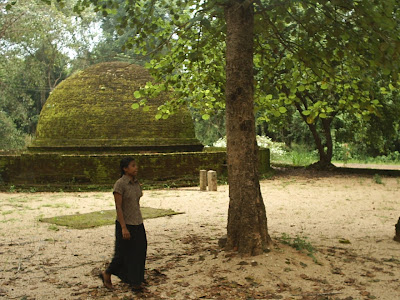
The size of the structure is illustrated by this photo of a senior citizen walking around it in the prescribed clock-wise manner. Note the multi-coloured branches of Na (Ironwood) trees in the foreground and the concentric perimeter rings (pesa walalu) at the base of the stupa.
 Elderly man circling the dagoba
Not withstanding the size of the dagoba, it is referred to as the Kotavehera (short stupa) , not because of any deficiency in its height, but because it was built without the usual upper structure, the traditional cube-shaped enclosure (hatharæs kotuwa) and pinnacle (koth kærælla). Rather like calling a tall person short because they do not wear a hat.
On the eastern side of the dagoba, just above the second of the pesa walalu at the foot of the dagoba, is a smaller stupa, about 11 metres (36 feet) in diameter. It is said to mark the exact place of Parakramabahu's birth. It is that little pimple on the side of the dagoba, in my stitch-up shot above. The photo below shows it in close-up:
 Smaller dagoba
 Smaller dagoba
Excavations found a koraha (a pot for washing rice in) beneath the smaller dagoba. Not surprisingly, however, it was the larger which yielded the greater treasure. The main reliquary chamber, guarded by multi-headed cobras (like the one at Oorusitano tank), was complemented by 8 others arranged geometrically around it. The artefacts found there were housed in a museum built close by.
 The way to the archaeological museum
A break-in occurred there not too many years ago, and the thieves got away with a large number of artefacts, especially some exquisite Buddha statues covered in gold foil. However, less monetarily valuable but priceless historically, the main prize of the collection was left behind. This was the elephant lamp.
 Elephant lamp
This elegant oil lamp is one of a pair taken from the heart of the dagoba - the other being at the Colombo Museum. The identical lamps are of the hanging type and each consists an oil receptacle surmounted by an elephant and its mahout. The whole is suspended by the apex of a torana above the elephant, which is affixed to a chain.

Detailed drawing of elephant lamp
The elephant figure stands in the middle of the oil receptacle, which can be filled with oil. There is also a reservoir for the oil in the elephant's belly (marked in white on black in the central figure above). Oil is poured in using the hollow of one of the forelegs as a funnel.
After the lamp is lit, the level of oil in the receptacle goes down. When it goes below the level of the hole in the funnel-foreleg, an ingenious hydrostatic arrangement makes the pachyderm 'urinate' oil until the level of oil returns above the beast's feet. Obviously, the creator of this marvel of physics was something of a piss-artist.
Despite the burglary, many valuable artefacts remain in the museum, not just from Dedigama but from archaeological sites in the Kegalle area generally, including some interesting inscriptions. There is also a representation of the nine reliquary chambers of the Kotavehera, showing what was found where, and photographs of the dig.
You can get to Dedigama by turning to the right off the Colombo-Kandy road at Nelundeniya and driving about 3 kilometres (2 miles).